
April 1, 2026
IELTS Reading Strategy: Build Accuracy First, Then Speed
A focused reading strategy for IELTS with question-type tactics, timing control, and error patterns that most candidates miss.
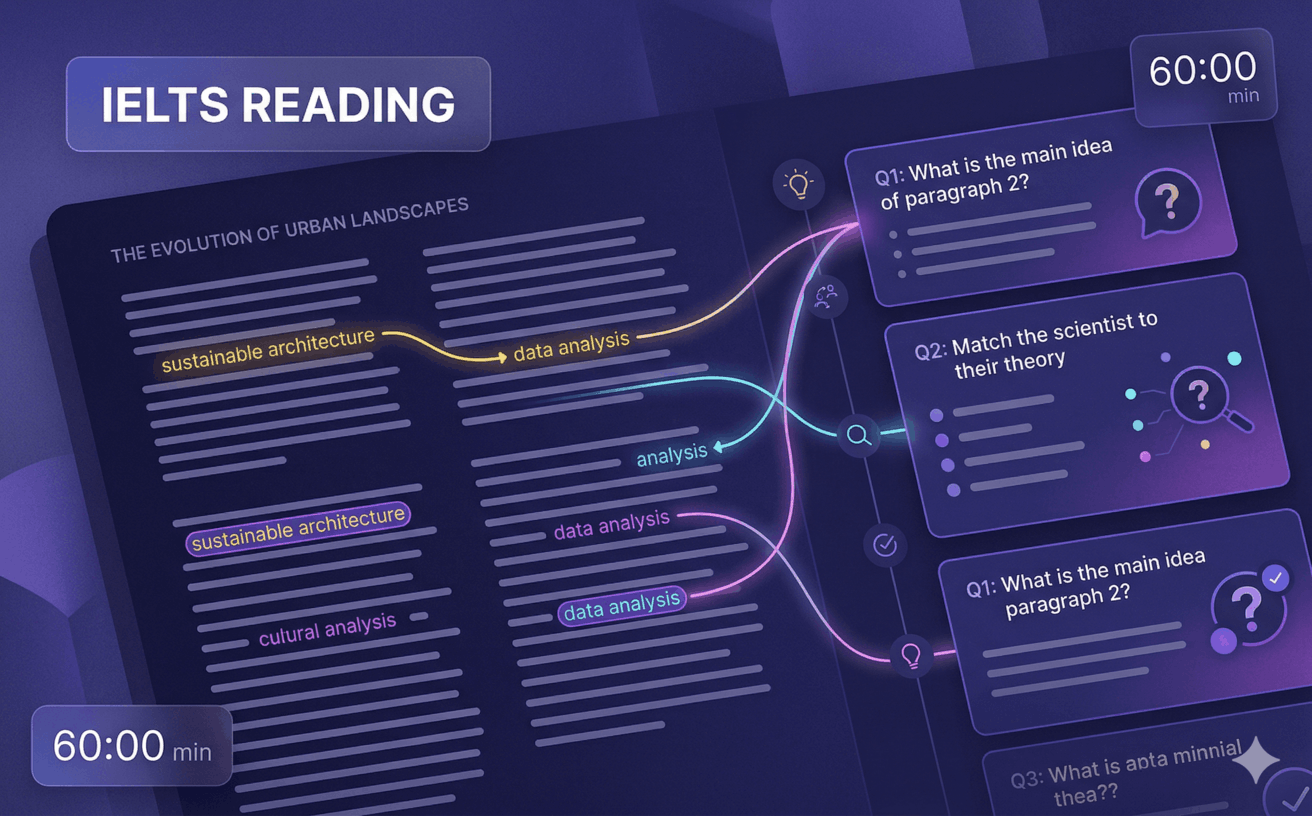
IELTS Reading is not a vocabulary contest. It is a decision-quality test under time pressure.
- Accuracy-first produces faster long-term score gains.
- Question-type drills outperform random full-passage practice.
- Error labeling is mandatory for progress.
- Reading every line deeply before seeing questions.
- Ignoring qualifiers like "not", "mainly", "except".
- Spending equal time on all passages.
- Set target minutes per passage.
- Track 3 error categories after each drill.
- Review one missed question with full reasoning.
The Core Problem
Most candidates read every paragraph deeply. That burns time and reduces concentration for harder questions.
Better Workflow
- Read the question first
- Identify keyword families (not single words)
- Locate likely paragraph zone
- Confirm meaning before final answer
Question-Type Priorities
- True/False/Not Given: test logical precision
- Matching Headings: test idea recognition, not detail recall
- Sentence Completion: test lexical and grammatical fit
Train each question type separately before combining them.
Timing Model (60 Minutes)
- Passage 1: ~15 minutes
- Passage 2: ~20 minutes
- Passage 3: ~25 minutes
Use passage difficulty, not equal time, as your rule.
Error Types to Track
After each practice set, label errors:
- Misread instruction
- Missed negation or qualifier
- Wrong paragraph location
- Guess under panic
If you only track "wrong answers," progress stays slow.
Score Improvement Rule
Reading band increases when you reduce repeated cognitive mistakes, not when you read faster blindly.
1. What should come first in IELTS Reading?
2. Should passage time always be equal?
3. Which is a high-impact reading error?